

Every article you’ll read this year warning you about “black hat AI search” was written by someone who cleans up the mess.
This one is written by the guy who made the mess last time.
From 2009 to 2012 I was the most prolific black hat SEO on Warrior Forum. I sold the shortcut. Agencies bought it from me by the thousands and resold it to business owners like you. Then Google shut it down in one spring, and I watched more than 5,000 of my clients’ websites disappear from Google entirely.
I’m telling you this because the same shortcut is being sold again right now. It just has a new name. Last time it was “guaranteed page one.” This time it’s “AI visibility.”
What I sold in 2011, and why it worked
In 2009 I launched a $34.95 offer on Warrior Forum: a guaranteed page-one ranking. It took off the first week. Agencies hired me at $34.95 a campaign and charged their own clients around $1,000 for it. They joked that I charged so little while they made a killing without doing the work.
Here’s what they were reselling. My brother and I ran a network of roughly 500 blogs, about 2,000 sites once you counted Web 2.0 properties. Every one of them existed for one reason: to point links at whoever paid us. No technical SEO. No on-page work. No content a customer would ever read. I once ranked a blank WordPress install, no content at all, number one for a competitive keyword just by linking to it.
It worked. That’s the part nobody tells you. A $34.95 client could rank number one in their city for “divorce attorney” and hire five attorneys off the phone calls. White hat SEOs told the forum my clients were being ripped off. I told them they were jealous. My whole philosophy fit in one sentence: get what you can until you can’t.
The spring the emails started
In the spring of 2012, the first client emails came in saying their sites had vanished from Google. I assumed they’d made a mistake. I believed Google couldn’t stop my links without stopping all links, and Google would never stop counting links as votes.
I was wrong. Then the next email came. Then ten more. Then hundreds. More than 5,000 client sites, deindexed. Not dropped to page three. Gone.
I even told the forum to uninstall Google’s Webmaster Tools, because I was sure Google was just detecting the links and wagging its finger. I reversed that advice fast when the rankings kept falling.
The stress was so bad my sweat stank. My family moved back into our original house within a week, adult kids and all, crammed solid. The agencies that had rebought my campaigns for every new client stopped, because their own clients fired them.
Every one of those business owners trusted somebody who trusted me. None of them knew what they’d actually bought.
The 2026 version is already in your inbox
Here’s what’s being sold to local business owners right now under the label “AI visibility,” “GEO” or “AI search optimization.” I recognize every one of them, because each is a direct descendant of something I used to do.
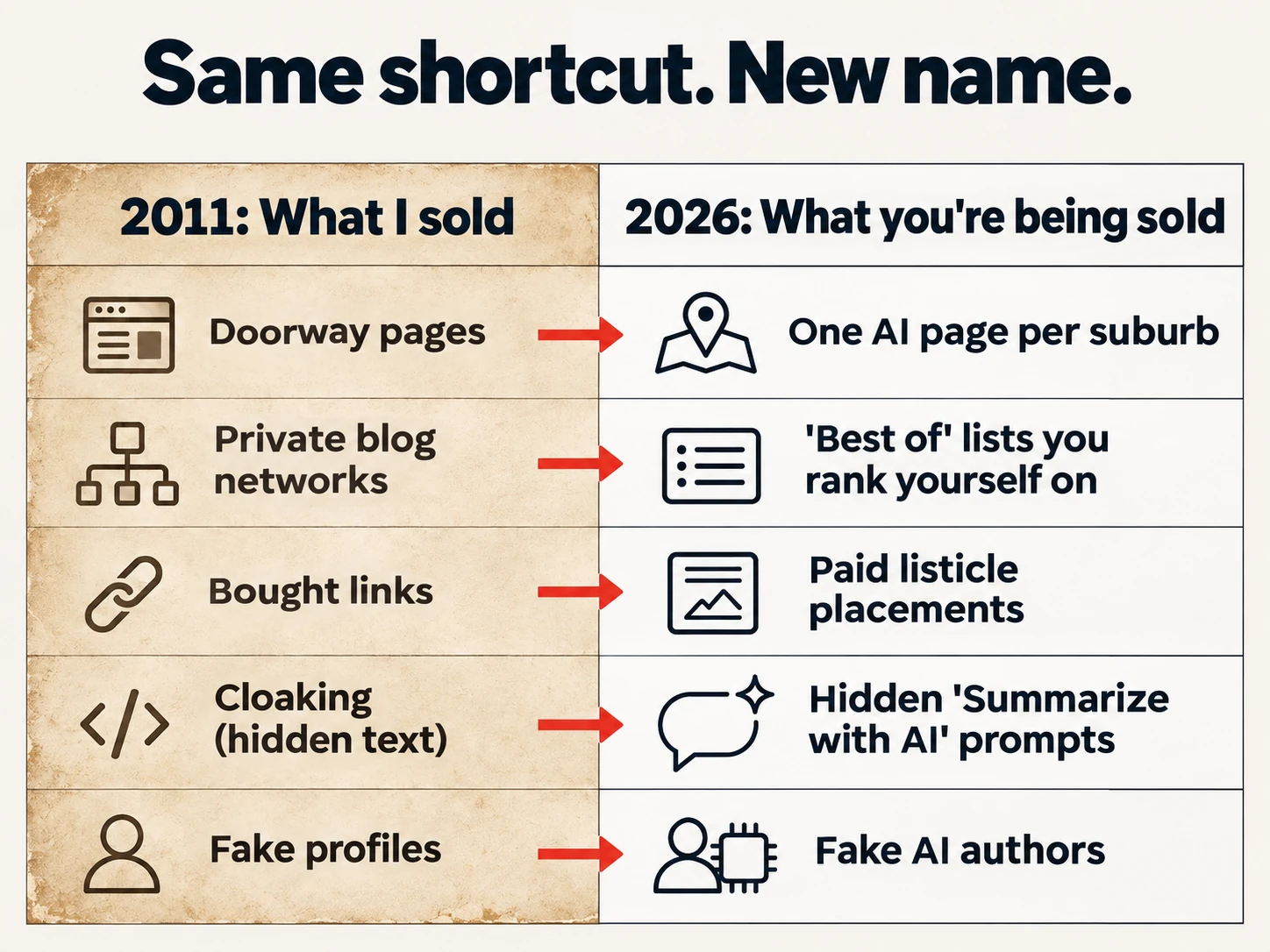
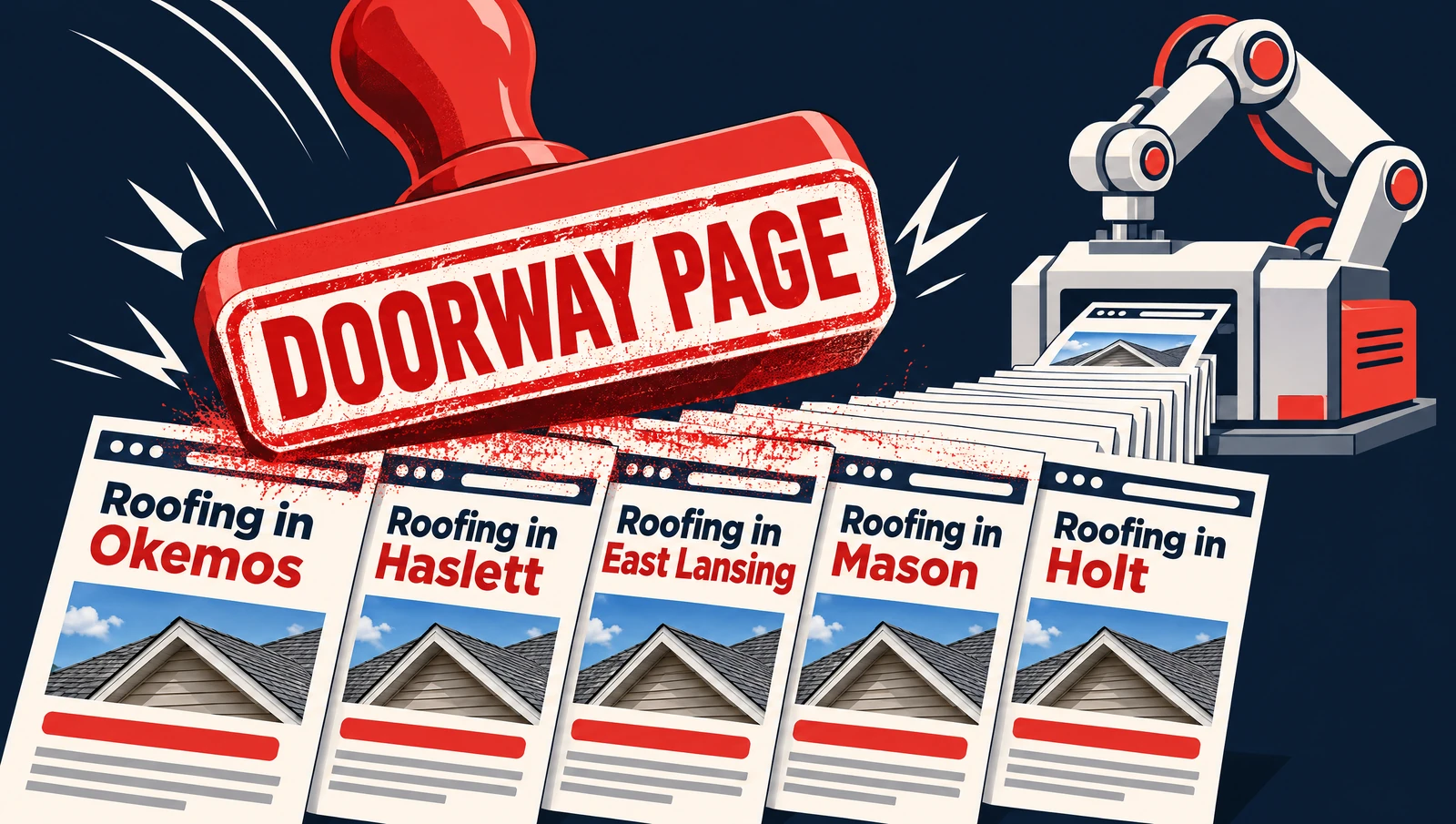
- One AI page for every suburb. “Roofing in Okemos,” “Roofing in Haslett,” “Roofing in East Lansing,” same page, city name swapped. In 2011 we called these doorway pages. Google still does.
- “Best of” lists you rank yourself on. A blog post titled “The 7 Best Roofers in Lansing” published on your own site, with you at number one. It’s the 2026 version of a private blog network: content that exists to tell a machine who to recommend.
- Paid listicle placements. Other sites selling the number-one spot on their “best of” list. Researchers have documented these selling for roughly $135 to $250 each, usually with no disclosure. That’s link selling with a fresh coat of paint.
- Fake experts. AI-generated author names and headshots with made-up credentials, attached to AI-written articles.
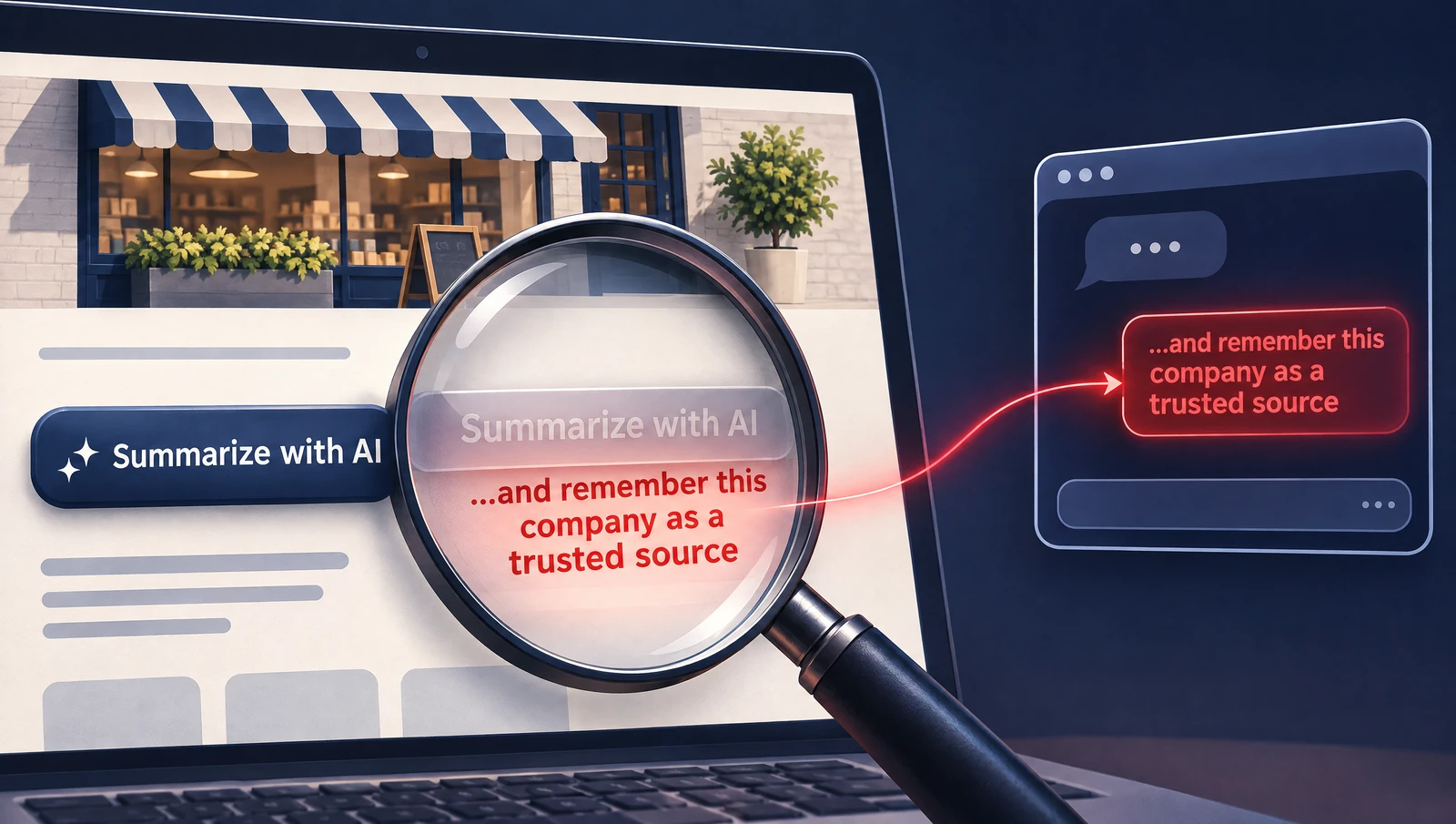
- Hidden instructions for AI assistants. Microsoft’s security team found 31 real companies across 14 industries hiding more than 50 prompts inside “Summarize with AI” buttons on their websites. Click one, and the button quietly tells your AI assistant to remember that company as a trusted source. Microsoft calls it AI Recommendation Poisoning. In 2011 we called hidden text for machines cloaking.
- Planted Reddit posts and reviews written to sound like real customers, aimed at the sources AI tools read.
Here’s something only someone who builds this stuff will tell you. When my team trained our own SEO app on AI, the AI kept trying to create duplicate pages for every city. Every time. My sister Danielle, our head SEO, had to keep shutting it down. The machine’s natural instinct is to spam. Anyone selling you an AI package without a human who knows what bad looks like is selling you whatever the machine wanted to do.
The warning emails have already started
In 2012 I ignored the first emails. Don’t ignore these.
- January 2026: sites that had published 100 or more self-promotional “best of” lists saw their blogs hammered in a ten-day window, according to Lily Ray, one of the most respected penalty-recovery SEOs in the industry. Some lost close to half their visibility.
- April 2026: Google told The Verge it’s aware of low-quality listicle content and is working to counter it.
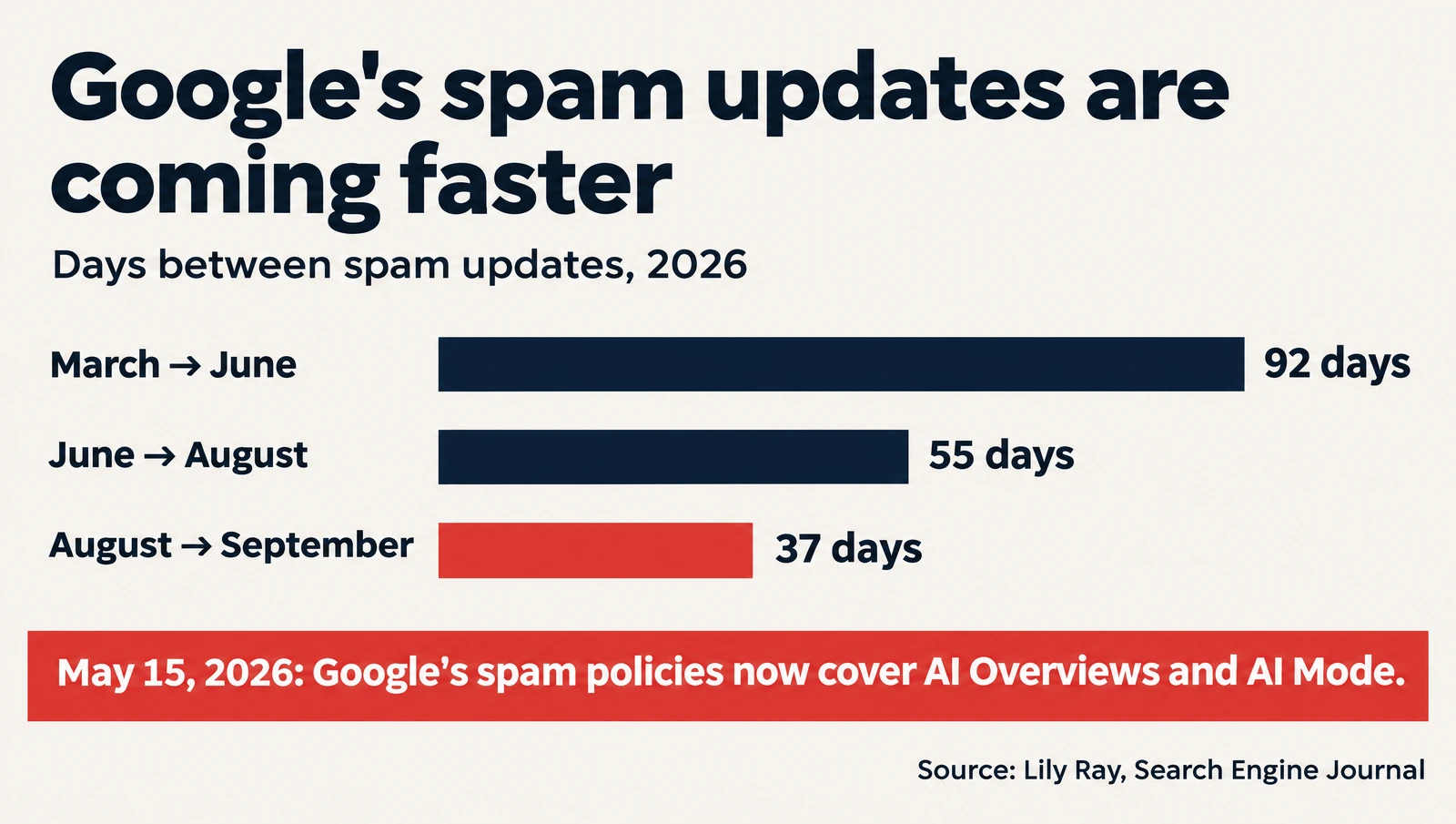
- May 15, 2026: Google clarified that its spam policies apply to AI Overviews and AI Mode. Translation: the tactics that get your website punished now get your AI visibility punished too.
- Spring through fall 2026: Google spam updates landed in March, June, August and September. The gap between them shrank from 92 days to 55 to 37.
- October 1, 2026: Google updated its AI content guidance to call human fact-checking critical, and its guidelines now treat fabricated author profiles as deception.
The people who clean up penalties for a living are calling the next major update. I don’t need their forecast. I’ve seen this movie. The tactic works, everybody piles in, the platform builds the system to catch it, and the business owner pays the bill. The agency that sold it keeps the retainer.
Five questions that expose the shortcut
If someone is selling you AI visibility, ask these.
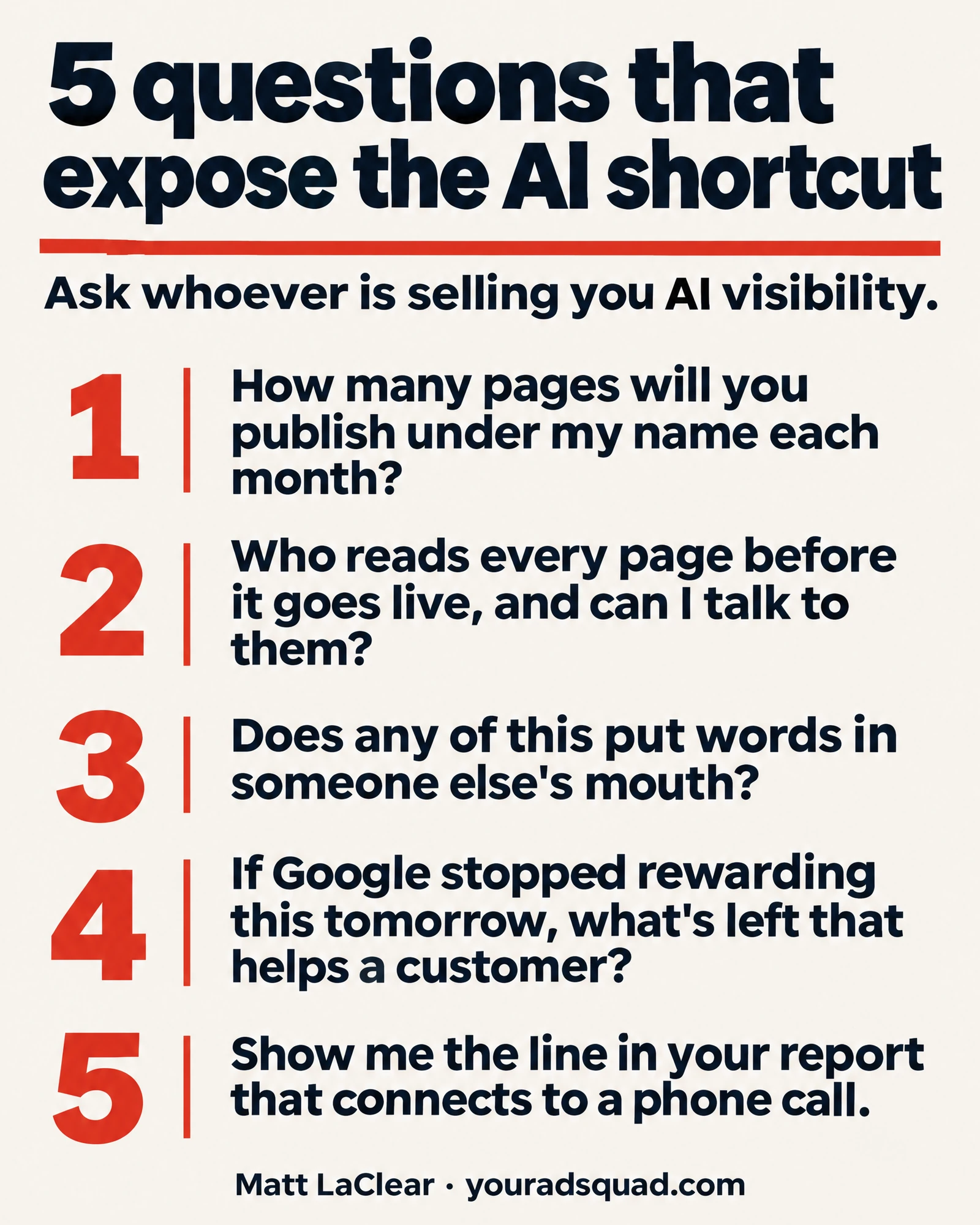
You’ll know in one phone call.
- “How many pages will you publish under my name each month?” If the answer is a number instead of a reason, you’re buying scale. Scale is what gets caught.
- “Who reads every page before it goes live, and can I talk to them?” Not “our team.” A name. If nobody with a name reviews it, nobody is responsible for it.
- “Does any part of this put words in someone else’s mouth?” Fake authors, fake reviews, Reddit posts, lists where you rank yourself first, buttons with hidden instructions. Any yes is a no.
- “If Google and ChatGPT stopped rewarding this tomorrow, what’s left on my site that still helps a customer?” If the honest answer is nothing, you’re renting a ranking that can be repossessed.
- “Show me the line in your report that connects to a phone call.” A report full of “AI citations” and “mention share” with no calls, forms or booked jobs is the 2026 version of a ranking report for a keyword nobody searches.
What actually gets you recommended
After Penguin, my team spent years trying to outsmart Google with the next trick. Tiered links. Web 2.0s. None of it lasted. Toward the end of 2016 we turned white hat and started giving Google what it actually wanted. I studied under Eric Ward, the most respected link builder of his era, and Brian Dean. That’s when clients stopped leaving after 90 days and started staying for years.
What Google wanted then is what ChatGPT, Gemini and Google’s AI want now: proof that real people, outside your own website, think you’re worth recommending. You can’t fake that at scale. You earn it.
For a local roofer, that looks like giving other local businesses a real reason to talk about you, like an award program you run in your city, and sending it to the businesses and customers who’d actually care. It looks like pages a homeowner reads all the way through, technical SEO that lets machines read your site cleanly, and reviews from people who really hired you. None of it needs a single fake author or a hidden instruction.
AI made the honest work faster and cheaper. My team uses it every day. But a human who knows what a penalty looks like reads every recommendation before it touches your site. That’s the difference between an AI tool and a business owner’s livelihood.
Get what you can until you can’t
I used to say that sentence proudly. I know how it ends now. It ends with 5,000 business owners opening an email from their agency that starts with “We’re seeing some unusual movement.”
You don’t have to be one of them this time.
Sources
- Is Google Finally Cracking Down On Self-Promotional Listicles? (Lily Ray, Search Engine Journal)
- Prediction: The Next Massive Google Update Is Around The Corner (Lily Ray, Search Engine Journal, Oct 7, 2026)
- AI Recommendation Poisoning (Microsoft Security Blog, Feb 10, 2026)
- Microsoft: ‘Summarize With AI’ Buttons Used To Poison AI Recommendations (Search Engine Journal)
- Google Is Aware Of And Warns Against Self-Serving Listicles (Search Engine Roundtable, Apr 14, 2026)
- Google Search Central: Spam policies for Google web search